

The play's subtitle is A Way to Plan Dreams. To liberat plan dreams, these are a couple of possible ways to freedom. This production was not only a neurological study but also a restructuralization of the Sekai by imagination. The word Sekai in this case should be translated as Cosmos rather than World. * * * Instead of being tied to the barrenness of the so-called physical theatre of the past, which was centered on actors, I and my theatre have expanded the confrontation with art to the realm of objects. I think that the physicality of actors can be manipulated by memory. To me this is a very sub- jective approach to theatre, leading only to the subconscious of an isolated individual. Unless the theatre is liberated from all memories, acting will remain an imitation or representation of the actor's own past. I say farewell to Mr. Grotowski! Our theatre, Tenjo-Sajiki, is discovering and incorporating new dynamics that include objects, such as buildings and trees, as well as the historical coincidence we call dramaturgy. Translated by Kazuko OshimaTranslated by Kazuko OshimaTranslated by Kazuko Oshima
Terayama, Shuji, and Kazuko Oshima. “Farewell to Grotowski!” The Drama Review: TDR, vol. 17, no. 4, 1973, pp. 51–52. JSTOR, https://doi.org/10.2307/1144828. Accessed 16 Oct. 2024.
Uploaded image
Uploaded image
[
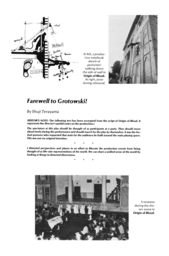
Shuji Terayama has become the hero of the festival. He has already been placed on the festival pantheon of demi-gods like Brook, Grotowski, Stockhausen, Wilson, and Cage, who made Shiraz one of the most forward-looking institutions in the world," so wrote a Tehran critic the day after seeing the Tenjo Sajiki Laboratory Theatre performance of Origin of Blood. The critic went on to say that the Japanese piece "defied description" as there was no plot. "It is a total experience-something like an LSD trip or the sudden revelation of awesome beauty that is supposed to emerge after prolonged Sufi dances." The Origin of Blood was performed on the last three nights of the festival in the Delgosha Garden, part of a large aristocratic Shiraz estate that has been taken over by the government for restoration. The performance began each night at 11 p.m. and lasted about an hour and a half. As spectators approached the wrought-iron gate that guarded the entrance to the estate and garden, they could see some of the actors either sitting on walls or standing behind glass partitions that blocked all but two circular entrances to the garden. These actors were immobile and looked like dummies. One actress, sitting on a wall, held a sign that read "Dragon" in Japanese. An actor, sitting on a wall opposite her, held a small, life-like puppet in his lap. A large fire burned in a cauldron in the enrance way, and a huge spotlight pointed out from behind a glass partition, giving an eerie, supernatural quality to the entrance environment. The spotlight gave the feeling of a large eye watching from another planet. The spectator walked down a long, elevated, cement pathway with gardens on either side toward a large house, resembling, with its two huge pillars, a Southern plantation, except that the facade was in beautiful brown mosaic tile. The main stage area was just outside the front steps to the house. The audience was initially unaware that the long stage platform had been built over a goldfish pond. The spectators sat on three sides of the thrust playing space. The playing area was bathed in red and blue light, the spots mounted on the roof of the three-story building and on high platforms situated behind the spectators and half hidden by trees. In the center of the playing space was a large, ornate table with six heavy, carved dining-room chairs around it. A strange Oriental bird with blue-and- yellow feathers and the beak of a parrot walked on the table, his foot secured by a long string to one of the chairs. The piece begins when a tall, sinister-looking actor walks slowly down the en- trance way on a long red carpet that is laid out before him by another actor. The carpet is laid over the chair at the head of the table and then across the table to the other head chair. The tall actor in whiteface and wearing a black cloak never misses a stride as he walks up over the chair and table and then, as he is walking off the table and end chair, suddenly breaks his cane over the head of the actor who has been laying out the carpet. All the while, a small Japanese actress has been moving beneath the table on her hands and knees, half dancing and half exhibiting fear. During the entire performance, there is live electronic music, sometimes a weird mortuary sound and sometimes an Oriental rock rhythm. While the tall actor is making his appearance, lights come up on a clump of pine trees at the right side of the house. The spectator notices scaffolding and then one-by-one the hanging of five plastic bags with semi-naked actors and actresses inside them. The appearance is that of "embryos" growing on trees. The program informs the spectator that there is a Chinese legend that states that human beings once grew on trees like fruit. "This drama," the program continues," is the history of a five-member family that was picked from a single tree (a metaphor of the blood line of that family). In contrast to the belief that family relationships are de- cided by fate, this drama points out that a family can be freely assembled in any number of new ways. It denies blood relationships and presents a new type of family relationship." After the tall actor has cracked his servant over the head, the focus of the spectator's attention swings to the bodies in the plastic bags hanging from the "tree." Suddenly, the front door of the house bursts open and six doctors, dressed in white coats and white caps, with masks over their face, appear. They set up six clothing dummies near the table and then rush off to bring the five members of the family down from the tree. They carry each member in and dress them. While this action is going on, a waiter, dressed in a Persian vest and wearing a fez-like hat, ceremoniously sets the table. Finally, all five members of the "family" are sitting at the table, where they take on the character of robots, moving in jerky puppet fashion. They strain to communi- cate but appear unable to do so. Meanwhile, actors and actresses, one dressed in a nun's garb, move about on the steps and entryway to the house. Some performers ap- pear in the windows of the house, holding candles. An actress does an erotic dance in a small space in front of the table, swinging a torch on a chain around herself. (On the first night of the performance, the actor sitting at the head of the table suddenly turned and spit flame over his shoulder. Instead of staying within the playing space, the flame landed on the front row of spectators, covering this writer, his wife, and Madame Ninon Tallon Karlweis, an international theatrical agent who handles many experimental troupes. Although Madame Karlweis' face was badly burned, and she was taken to the hospital, there was no break in the performance. The actors instead used the incident by poking torches at the spectators to heighten the sense of excitement and fear. Many in the audience, in fact, thought that the spectators en- gulfed in flame were part of the show.) With the action continuing, a trap door on the right side of the table suddenly opened, turning up a toilet bowl which was subsequently used by an actor. As the trap door opened, an actor emerged dripping wet from the pool beneath and ran into the house. The program explained: "When the youngest daughter pricks her white finger on the briar of a red rose, blood begins to flow from the house itself. Parent and child vampires come flying through the air. It is water that seals the curse! The oldest son stays under water and is thus able to escape from the vampires." The vampire image is reinforced when the audience discovers that an actor has climbed out a third-story window and is walking down the front of the house. His en- trance in and out of the windows is covered by smoke bombs. Meanwhile, the five members of the family leave the table and run desperately into the house pursued by the doctors. The piece comes to a conclusion with the tall actor's reappearance. He proceeds to break the table into pieces, leaving the playing area totally devastated. The audience is then invited to follow the family into the house. Many specta- tors-there were about four hundred at each performance-rushed into the house at the first beckon. The central room inside the house was a circular chamber three tories high. The chamber was lit by fires in several cauldrons placed throughout the house. Actors appeared on balconies on the second and third levels and began to speak to the spectators about revolution in theatre and in their own lives. After about ten minutes inside the house, the spectators were led out by an actress dressed as a bride. As the audience left, the music reached a crescendo and several smoke bombs were set off. The program noted: "The audience is invited into a house by this weird family, which is a labyrinth of blood and blood vessels. This house of blood is the passageway for the audience." The piece was over, but as spectators walked down the long, narrow pathway, ac- tors appeared on the roof of the building and in windows, continuing their remarks. Spectators looking over their shoulder could see fireworks shooting into the sky from the top of the building, which was bathed in a smoke-filled blue light. There was a sense of destruction in the air. The next day at a press conference, Terayama said that the largest influence on his work was Artaud. It was also evident to many critics present that the Japanese di- rector's piece had been influenced by Robert Wilson's Deafman Glance (the family at the table with a bird on it). But most of the conference dealt with the flame-spitting incident (the subject also came up for discussion at the Third World conference). Terayama maintained that the incident was an accident. Several of those present at the conference suggested that he was callous in not stopping the performance to attend to the injured spectators: He was directing the timing of the performance from a tower only twenty yards from the incident and clearly saw what had happened. The Japanese director said that the responsibility for stopping the action rested with the actor, who he admitted had not rehearsed the flame-spitting technique before the opening performance. It was learned that Terayama had sent a bouquet of roses to Madame Karlweis along with a note that had "I'm sorry" written on it one hundred times. The fire incident took on an added dimension when Terayama confirmed reports that there had been several other instances of spectators being hurt at his perfor- mances. At a BITEF festival performance two years ago, his actors actually got in a fight with some spectators after speaking to them in Serbo-Croat. At the Mickery Theatre in Amsterdam earlier this year, some spectators were overcome with claustrophobia during a piece that was designed to have just that reaction. Terayama said that he was out to eliminate the "artificial frontiers" between drama and reality. "When my actors do something outrageous as part of the play, or get beaten up by the spectators, those frontiers are eliminated. I'm pleased by this." On this note, the Seventh Festival of Arts, for all practical purposes, had come to an end